
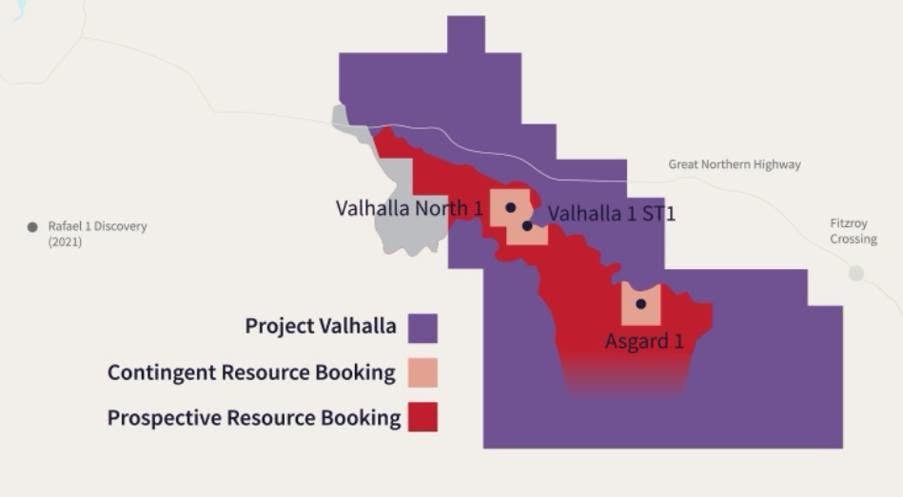
Today is the final day to make comments on the Valhalla Gas and Appraisal Program.
The proposed action, Valhalla Gas Exploration and Appraisal Program was referred to the Minister for Environment on 16 September 2024 (2024/10006). It was determined that additional information (Preliminary Documentation) is required to inform the assessment and a decision on the Project under the EPBC Act. You are invited to make a comment on the draft Preliminary Documentation for the proposed action.
The purpose of the proposed action is to confirm and appraise the positive results from previous exploration activities within EP 371.
The proposed action includes the construction of up to twenty (20) exploration wells on ten (10) well sites, under two phases.
The initial six (6) wells to be developed under phase I are believed to be the most gas prospective and are strategically located to de-risk Phase II drilling activities. If Phase I indicates commercial production is economically feasible, it will be followed by the Phase II drilling program involving up to fourteen (14) wells.
Site preparation at each well site will involve civil activities including clearing of vegetation and construction of well sites, construction of well site ponds, pits, sumps, and well cellars and installation of groundwater extraction and monitoring bores.
Drilling activities will then comprise mobilization of the drilling package, ancillary services, rig camp, personnel and supplies, completion of drilling activities and casing and suspending the well, or if required, plugging and decommissioning the well.
Hydraulic fracture stimulation (HFS) activities will comprise the mobilization of HFS spread (equipment), personnel and supplies, well perforation and clean-up, HFS treatment and well testing.
The types and use of HFS fluids used for HFS treatment have evolved greatly over the last 60 years and continue to evolve due to the investment of significant research effort. This has led to the development of ‘green’ HFS fluids that optimise environmental objectives and outcomes. One of these is Halliburton’s CleanStim Aus® HFS fluid system, which is proposed to be used for this program. Ecotoxicity testing of the combined fluid system was previously undertaken by the previous operator and demonstrated that the fluid system is of very low toxicity (Buru Energy, 2018). For a detailed description of the chemicals planned to be used, refer (Att 3 – Valhalla Gas Exploration and Appraisal Program Section 38 Assessment – Environmental Review Document, Appendix A). Following the completion of well testing, site reinstatement/decommissioning will comprise the suspension or shutting in of the wells, plugging decommissioned wells permanently with multiple concrete plugs (in accordance with Department of Energy, Mines, Industry Regulation and Safety (DEMIRS) accepted Well Management Plan), removal of all infrastructure from the sites, environmental sampling to ensure contamination has not occurred, and to address any contamination issues, draining and backfilling ponds, sumps, and pits, ripping and contouring hardstands as required and the respreading of topsoil and stockpiled vegetation.
Over the course of the project, water will be extracted, injected and separated from the produced fluid stream. A detailed description of water, fluids and gas cycle over the course of the project (including flow diagram and water balance assessment), is provided in (Att 3 – Valhalla Gas Exploration and Appraisal Program Section 38 Assessment – Environmental Review Document, Section 2.4.4 pp 61-65). No additional developments are happening as part of the proposed action.
For further information about the Proposed Action, each component is described in detail within (Att 3 – Valhalla Gas Exploration and Appraisal Program Section 38 Assessment – Environmental Review Document, Section 2 pp 56-70)
The Proposed Action may have direct and indirect impacts on the environment.
Direct impacts may include:
Habitat loss – site preparation activities
Vehicle strike – site preparation activities, drilling activities and vehicle / equipment movement
Indirect impacts may include:
Light emmissions– site preparation activities and drilling activities
Noise and vibration emissions– site preparation activities, drilling and HFS activities
Dust emissions – site preparation activities, drilling activities and vehicle / equipment movement
Changes to fire regimes – site preparation activities and drilling activities
Introduction or spread of weeds – site preparation activities and vehicle / equipment movement
Water resource impacts – water extraction activities, aquifer contamination
See Section 4.1.4 and Att 9 – Assessment of potential impacts to MNES for further details.
The Project Area comprises a total area of ~210 ha, which includes all well sites, access tracks, camp and the existing road (Calwynyardah-Noonkanbah Road, an existing gravel road which branches south from the sealed Great Northern Highway). The estimated disturbance footprint for the well sites, access tacks and camp is ~110 ha.
Att 6 – Project Figure, shows the Project Area including labelled well sites, the intended camp site and associated access tracks. The Calwynyardah-Noonkanbah Road is an existing public use road but has been included in the Project Area even though no additional development is required on this road. All assessments completed in this referral are based upon the most conservative and highest potential disturbance (clearing) numbers to ensure the maximum potential impact has been assessed noting that under this referral, no more than ten (10) wellsite’s and associated access tracks will be cleared. – From EPBCA Website
There are no avoidance and / or retention areas associated with the Proposed Action.
Submissions are managed by proponents at this stage, so need to be completed via Black Mountain Website
Topics to comment on:
Largetooth Sawfish (Pristis pristis)
Northern Blue-Tongued Skink (Tiliqua scincoides intermedia)
The Greater Bilby (Macrotis lagotis)
Water Resources
National Heritage
Further information can be found https://epbcpublicportal.environment.gov.au/…/proje…/…
Image: Black Mountain Website